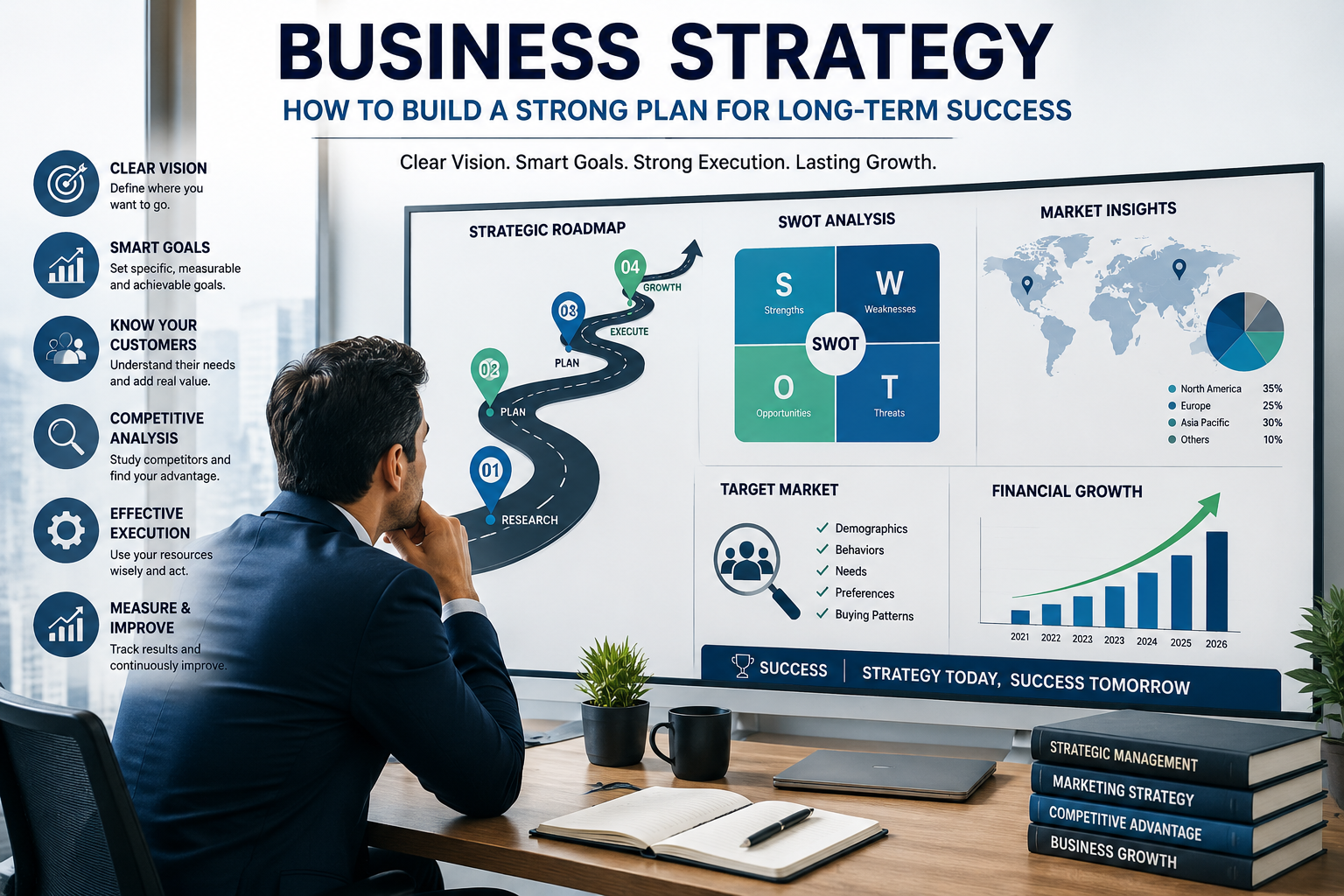
A successful business rarely grows by accident. Behind most sustainable companies is a clear business strategy that defines where the business wants to go, how it will compete, who it wants to serve, and what actions are needed to achieve its goals. Whether you are launching a startup, managing a small business, or leading an established company, a strong strategy can help you make better decisions and respond to changing market conditions.
A business strategy is more than a document filled with goals and financial projections. It is a practical framework for turning a business vision into measurable results. The right strategy helps organizations focus their resources, understand customers, manage risks, build competitive advantages, and create long-term value.
In this guide, we will explain what business strategy means, why it matters, the key elements of a strong strategy, and how businesses can create a practical plan for long-term success.
What Is Business Strategy?
Business strategy is a long-term plan that explains how a company will achieve its objectives and compete successfully in its market. It connects the company’s goals with specific actions, resources, customers, and competitive positioning.
A strategy answers important questions such as: Who are our target customers? What problem are we solving? What makes our business different? Which markets should we focus on? How will we generate revenue? What resources do we need? And how will we measure success?
For example, a small online clothing business may decide to compete through affordable products, fast delivery, strong social media marketing, and excellent customer service. These choices become part of its overall business strategy and guide everyday decisions.
Why Is Business Strategy Important?
A clear strategy gives a business direction. Without a defined plan, companies can easily spend money and time on activities that do not contribute to meaningful growth. A strategy helps management prioritize the opportunities that are most valuable.
It also improves decision-making. When businesses understand their objectives, target market, competitors, and available resources, they can evaluate new opportunities more effectively. Instead of following every trend, they can focus on activities that support their long-term goals.
Another important benefit is adaptability. Markets change because of technology, customer preferences, economic conditions, and competition. A good strategy does not mean following one rigid plan forever. Instead, it provides a framework that can be reviewed and adjusted when circumstances change.
Key Elements of a Strong Business Strategy
A successful business strategy normally includes several connected elements. Each one contributes to the company’s overall direction.
1. Clear Vision and Mission
The first step is understanding what the business wants to achieve. A vision statement describes the long-term destination, while a mission explains the company’s purpose and the value it provides.
For example, a technology company might have a vision of becoming a trusted provider of affordable business software. Its mission could focus on helping small companies automate repetitive tasks and improve productivity.
Clear vision and mission statements help employees and decision-makers understand what the organization is working toward.
2. Specific Business Goals
A strategy needs measurable goals. Instead of saying that the business wants to “grow,” define what growth actually means.
Goals could include increasing annual revenue, gaining a specific number of customers, entering a new market, improving customer retention, reducing operating costs, or launching new products.
Using SMART goals—specific, measurable, achievable, relevant, and time-bound—can make objectives easier to track and manage.
3. Understanding the Target Market
Knowing your customers is one of the most important parts of business strategy. A company should understand who its ideal customers are, what problems they experience, what they value, and why they choose one product or service over another.
Market research can reveal customer needs, purchasing behavior, market size, emerging trends, and gaps that competitors are not serving effectively.
Businesses that understand their audience can create more relevant products, marketing campaigns, pricing strategies, and customer experiences.
4. Competitive Analysis
Every business operates within a competitive environment. An effective strategy requires an understanding of direct and indirect competitors.
Analyze competitors’ products, prices, customer service, marketing channels, strengths, weaknesses, and market positioning. The goal is not simply to copy successful competitors. Instead, the information should help you identify opportunities to differentiate your business.
A company might compete through lower prices, superior quality, specialized expertise, faster service, convenience, innovation, or a better customer experience.
5. Unique Value Proposition
A value proposition explains why customers should choose your business instead of an alternative.
A strong value proposition is specific and customer-focused. It should communicate the main problem your business solves and the benefit customers receive.
For example, “We sell software” is too general. A stronger proposition might explain that the company provides simple accounting software designed specifically for small businesses that want to manage invoices and expenses without complicated systems.
6. Revenue and Business Model
Your strategy should clearly explain how the business makes money. This is known as the business model.
Revenue may come from product sales, subscriptions, consulting services, advertising, licensing, commissions, memberships, or a combination of different sources.
Understanding the revenue model helps businesses evaluate pricing, costs, profit margins, customer acquisition expenses, and opportunities for expansion.
How to Build a Business Strategy Step by Step
Creating a strategy becomes easier when it is divided into practical steps.
Step 1: Define Where You Want the Business to Go
Start with your long-term vision. Decide what success should look like in three, five, or more years.
Think about the size of the company, target customers, products or services, geographic markets, revenue goals, and competitive position you want to achieve.
A clear destination makes it easier to decide which opportunities deserve attention.
Step 2: Analyze the Current Situation
Before deciding what to do next, understand where the business stands today.
A SWOT analysis can be useful. It examines:
- Strengths: Internal advantages of the business
- Weaknesses: Internal limitations or problems
- Opportunities: External possibilities for growth
- Threats: External risks and competitive pressures
This analysis provides a realistic picture of the business and can highlight areas that require immediate attention.
Step 3: Study Customers and Competitors
Research your target audience and competitive landscape. Look at customer reviews, industry trends, competitor websites, pricing, social media activity, and available market data.
The objective is to discover what customers actually need and where your business can provide something better or different.
Step 4: Choose Strategic Priorities
Businesses cannot do everything at once. Select a small number of priorities that can have the greatest impact.
For example, a growing company may prioritize customer retention, improving its website, launching one new product, and reducing unnecessary operating costs rather than pursuing ten different initiatives simultaneously.
Strategic focus helps prevent wasted resources.
Step 5: Turn Strategy Into Action
A strategy only becomes valuable when it is implemented.
Create an action plan that identifies specific tasks, responsible team members, required resources, deadlines, and performance indicators. Every major strategic objective should have practical actions attached to it.
For example, if the objective is to increase online sales, actions could include improving product pages, optimizing search visibility, testing advertising campaigns, and improving the checkout process.
Measuring Business Strategy Performance
A strategy should be measured regularly. Without performance tracking, it is difficult to know whether the plan is producing results.
Businesses can use Key Performance Indicators (KPIs) such as revenue growth, profit margin, customer acquisition cost, customer retention rate, conversion rate, website traffic, average order value, and return on investment.
The right KPIs depend on the business model. A subscription company may focus heavily on retention and recurring revenue, while a retail company may pay closer attention to sales, inventory turnover, and average transaction value.
Review performance monthly or quarterly and compare actual results with strategic targets. If something is not working, investigate why and adjust the plan.
Common Business Strategy Mistakes to Avoid
One common mistake is creating a strategy that is too complicated. A plan does not need dozens of pages to be effective. It should be clear enough that decision-makers and employees understand the main priorities.
Another mistake is focusing only on competitors. Competitor research is important, but businesses should ultimately focus on customers. A company can outperform competitors by solving customer problems better rather than simply copying market trends.
Ignoring financial realities is another major problem. A promising idea may still fail if costs are too high, cash flow is weak, or customer acquisition is expensive. Strategic decisions should therefore consider both growth potential and financial sustainability.
Finally, businesses should avoid treating strategy as a one-time activity. Markets evolve, and successful companies regularly review their assumptions and adjust their priorities.
Business Strategy for Long-Term Success
Long-term success requires a balance between growth and sustainability. Businesses should not chase short-term revenue at the expense of customer trust, product quality, employee performance, or financial stability.
Investing in customer relationships can create lasting advantages. Loyal customers are more likely to make repeat purchases, recommend a company, and provide valuable feedback.
Innovation also plays an important role. Businesses should monitor technological developments, customer expectations, and industry changes. Innovation does not always mean creating a completely new product. It can also involve improving existing processes, services, pricing models, or customer experiences.
Strong leadership is equally important. A strategy needs people who can communicate priorities, allocate resources, make difficult decisions, and keep teams focused on shared objectives.
How Technology Supports Business Strategy
Technology has become an important part of modern business planning. Businesses can use analytics tools to understand customer behavior, automation to reduce repetitive work, and digital platforms to improve communication and sales.
Data can also make strategic decisions more accurate. Instead of relying entirely on assumptions, businesses can analyze sales patterns, customer behavior, marketing performance, and operational costs.
However, technology should support strategy rather than replace it. Buying new software or adopting artificial intelligence will not automatically create growth. Businesses should first identify a problem or opportunity and then select technology that provides a measurable benefit.
Final Thoughts
A strong business strategy gives a company more than a list of goals—it provides a practical framework for making better decisions and building sustainable growth. By defining a clear direction, understanding customers, analyzing competitors, developing a strong value proposition, managing finances, and measuring performance, businesses can turn ambitious ideas into realistic objectives.
The best strategies are also flexible. Markets, technologies, customer expectations, and competitors can change quickly, so businesses should regularly review their assumptions and update their priorities when necessary.
Whether you are running a startup, small business, or established company, the core principle remains the same: know where you want to go, understand how you will compete, take focused action, and measure what matters. With consistent execution and thoughtful adaptation, a well-designed business strategy can become one of the strongest foundations for long-term success.