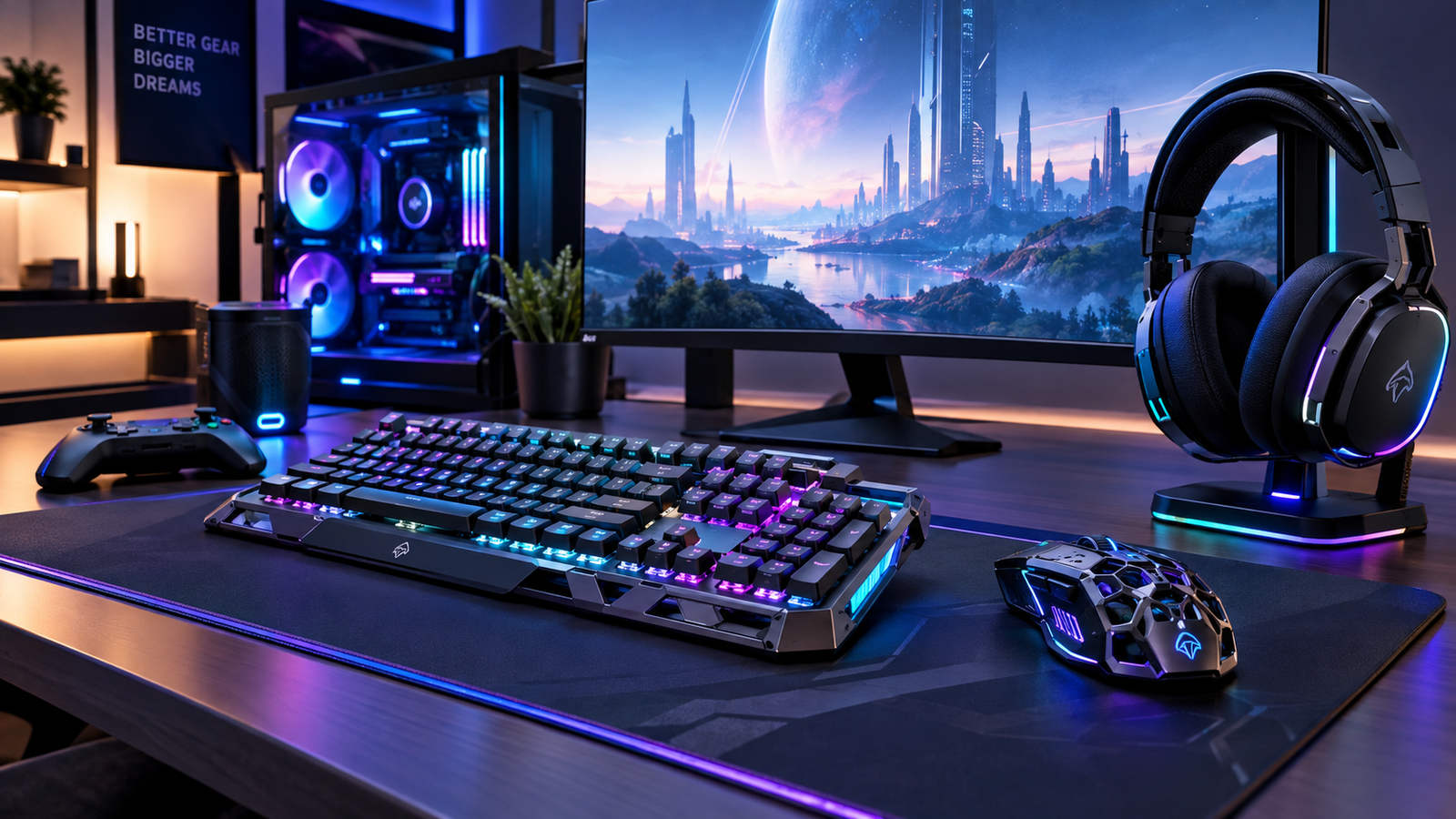
Gaming setups have changed dramatically over the past decade.
There was a time when choosing a keyboard or mouse was mostly about basic specifications. Gamers looked at DPI, switch type, response time, number of buttons, and perhaps RGB lighting.
Today, the situation is different.
Gaming peripherals have become an important part of the overall PC experience. Users increasingly care about materials, wireless technology, customization, desk aesthetics, lighting, and how different pieces of hardware work together.
At the same time, manufacturers are experimenting with aluminum and magnesium construction, exposed frames, transparent materials, Hall Effect switches, high polling rates, and designs influenced by science fiction.
This combination is creating a new generation of gaming hardware where technology and industrial design are increasingly connected.
Gaming Peripherals Are Becoming Part of the Setup
A modern gaming PC is rarely treated as a purely functional machine.
Tempered-glass cases, RGB lighting, custom cooling systems, matching desk mats, monitor arms, and carefully managed cables have transformed the gaming desk into something users deliberately design.
Peripherals naturally became part of that transformation.
The keyboard sits directly in the center of the desk. The mouse is used constantly. Speakers, headphones, microphones, controllers, and other accessories surround them.
As a result, manufacturers can no longer compete only on internal specifications.
Two keyboards may offer similar mechanical switches and connectivity but look completely different. Two gaming mice may use capable sensors while targeting entirely different users through weight, construction, shape, and materials.
For many buyers, the appearance of a device has become part of its value.
Why Gaming Hardware Is Becoming More Futuristic
Science-fiction-inspired hardware is not completely new, but modern manufacturing techniques have made more ambitious designs possible.
Instead of hiding every component inside a plain plastic shell, manufacturers can use:
- Aluminum alloy structures
- Magnesium alloy frames
- Transparent materials
- Skeletonized housings
- CNC-machined components
- Integrated RGB illumination
- Exposed structural elements
- Unusual geometric shapes
This approach creates products that look less like conventional office equipment and more like specialized pieces of technology.
GravaStar is one of the clearest examples of this design philosophy. The company currently produces gaming keyboards, mice, speakers and other accessories with a recognizable mechanical and science-fiction-inspired design language.
But appearance alone is not enough.
For futuristic peripherals to succeed, their engineering needs to keep up with their design.
Materials Are Becoming a Selling Point
Plastic remains one of the most practical materials for consumer electronics.
It is lightweight, affordable, durable, and easy to manufacture.
However, premium gaming hardware increasingly uses metals such as aluminum and magnesium.
These materials can provide greater rigidity while also allowing manufacturers to create more distinctive structures.
Aluminum Keyboards
Aluminum is particularly common in premium keyboards.
A metal chassis can make a keyboard feel more substantial and stable on a desk. It also provides manufacturers with greater opportunities to experiment with exposed structural designs.
Some modern gaming keyboards combine metal construction with internal sound-dampening materials and gasket-mounted structures, borrowing ideas that became popular within the custom mechanical keyboard community.
Magnesium Gaming Mice
Gaming mice present a different challenge.
Reducing weight is often more important than increasing it.
For that reason, magnesium alloys can be particularly interesting. Manufacturers can use thin or skeletonized structures while maintaining a premium metal construction.
The result can look dramatically different from a conventional plastic mouse.
However, material choice should always support the function of the device.
A metal peripheral is not automatically better simply because it uses more expensive materials.
Hall Effect Keyboards Are Changing Gaming
One of the most important developments in gaming keyboards has little to do with appearance.
It is the growth of Hall Effect technology.
Traditional mechanical keyboard switches generally rely on physical electrical contact to register a keypress.
Hall Effect keyboards detect changes in a magnetic field instead.
This allows compatible keyboards to measure how far a switch has been pressed.
That opens the door to features such as:
- Adjustable actuation
- Rapid trigger
- Custom reset points
- Analog-style input possibilities
- Different actuation settings for individual keys
For competitive gamers, especially players of fast FPS titles, this level of control can be useful.
A player may prefer extremely sensitive movement keys while using deeper actuation for keys that should not be activated accidentally.
Hall Effect keyboards have consequently moved from a relatively specialized technology into a major gaming-peripheral category.
GravaStar itself now offers Hall Effect models alongside traditional mechanical keyboards, showing how established peripheral brands are incorporating the technology into broader gaming ecosystems.
Polling Rates Continue to Increase
Polling rate has become another heavily marketed specification.
A peripheral’s polling rate represents how frequently it can report information to a connected computer.
For example:
- 1,000 Hz means up to 1,000 reports per second.
- 4,000 Hz means up to 4,000 reports per second.
- 8,000 Hz means up to 8,000 reports per second.
Higher polling rates reduce the amount of time between reports.
That does not mean an 8,000 Hz mouse or keyboard will instantly make someone a better gamer. Real-world benefits depend on numerous factors, including display refresh rate, system performance, game engine behavior, and the player.
Still, high polling rates demonstrate how manufacturers are increasingly optimizing peripherals for extremely low latency.
GravaStar’s current lineup, for example, includes 8,000 Hz gaming mice and Hall Effect keyboard models targeting performance-oriented users.
Wireless Gaming Has Improved Significantly
Wireless peripherals once carried a significant disadvantage.
Competitive gamers often avoided them because wired connections were considered more stable and responsive.
That perception has changed.
Modern gaming peripherals commonly offer low-latency 2.4 GHz wireless connections alongside Bluetooth and USB.
Many products now use what is commonly called tri-mode connectivity:
- USB wired connection
- 2.4 GHz wireless
- Bluetooth
Each mode serves a different purpose.
A gamer might use 2.4 GHz wireless for a desktop PC, Bluetooth for a laptop or tablet, and USB when charging or when a cable is preferred.
GravaStar’s mechanical keyboard lineup includes tri-mode models, while its wireless gaming mice similarly support wired, Bluetooth, and 2.4 GHz connectivity.
This flexibility is particularly useful for people who use the same workspace for both gaming and productivity.
The Growth of Complete Peripheral Ecosystems
Another interesting development is the rise of coordinated hardware ecosystems.
Traditionally, gamers might purchase:
- One company’s keyboard
- Another company’s mouse
- Another company’s speakers
- A completely different headset
There is nothing wrong with that approach, and it can often produce the best combination of products.
However, manufacturers increasingly want users to stay within the same ecosystem.
Part of the reason is software integration, but design consistency matters too.
A user building a futuristic setup may want the keyboard, mouse, and speakers to share similar materials, lighting, and visual characteristics.
This is an area where distinctive brands have an advantage.
Instead of competing only on individual product specifications, they can create a recognizable design language across several categories.
For example, users interested in this style can browse collections of GravaStar gaming peripherals spanning the brand’s distinctive approach to PC gaming hardware.
This makes it easier to think about peripherals as part of a complete desk setup rather than isolated accessories.
Mechanical Keyboards Are Becoming More Customizable
Customization is another major trend.
Features once associated mainly with dedicated keyboard enthusiasts have become far more common in mainstream gaming products.
These can include:
- Hot-swappable switches
- Replaceable keycaps
- Gasket-mounted construction
- Sound-dampening foam
- Programmable controls
- Custom RGB effects
- Multiple connectivity modes
- Different switch choices
Hot-swapping is particularly useful.
On a conventional soldered keyboard, changing switches can require specialized tools and technical knowledge.
A hot-swappable keyboard allows compatible switches to be removed and replaced much more easily.
This means users can change the sound and feel of their keyboard without replacing the entire device.
Design Still Cannot Replace Ergonomics
There is one important limitation to the futuristic-peripheral trend.
A product can look excellent and still be uncomfortable.
This matters particularly with gaming mice.
Mouse shape, button placement, size, grip style, and weight distribution can be more important than appearance.
Someone using a mouse for several hours every day should prioritize comfort before deciding which design looks best.
The same applies to keyboards.
Consider:
- Layout
- Key spacing
- Switch feel
- Wrist position
- Keyboard height
- Keycap profile
An attractive peripheral that causes discomfort will quickly become frustrating.
The best industrial design combines visual identity with usability.
Specifications Should Come Before Appearance
When comparing gaming peripherals, buyers should separate performance requirements from aesthetic preferences.
For a Gaming Mouse
Look at:
- Sensor quality
- Shape
- Weight
- Polling rate
- DPI range
- Wireless performance
- Battery life
- Button placement
For a Gaming Keyboard
Consider:
- Mechanical or Hall Effect switches
- Layout
- Polling rate
- Actuation options
- Connectivity
- Hot-swapping
- Software support
- Construction
For Gaming Speakers
Evaluate:
- Sound quality
- Frequency response
- Connectivity
- Stereo capabilities
- Volume
- Placement requirements
Only after those requirements are satisfied should appearance become a major deciding factor.
This approach reduces the risk of purchasing expensive hardware mainly because it looks impressive.
The Desk Is Becoming an Extension of the PC
Perhaps the biggest reason futuristic peripherals are gaining attention is simple: people interact with their peripherals more directly than almost any other computer component.
A powerful graphics card might be the most expensive component inside a gaming PC, but the user rarely touches it.
The keyboard and mouse are different.
They are physically used every time the computer is turned on.
Speakers, headphones, controllers, and desk accessories also become visible parts of the environment.
This gives peripheral manufacturers an opportunity that internal component manufacturers do not always have.
They can transform technology into something users display.
Minimalist and Futuristic Setups Can Coexist
Not everyone wants a desk that looks like the control center of a spacecraft.
Minimalist setups remain extremely popular.
They typically use:
- Neutral colors
- Simple keyboards
- Hidden cables
- Subtle lighting
- Clean desk surfaces
Futuristic setups take almost the opposite approach.
Instead of hiding the hardware, they intentionally make it visible.
Frames, structural elements, lighting, unusual materials, and mechanical details become part of the aesthetic.
Neither approach is inherently better.
The growing variety of designs is beneficial because users can choose peripherals that reflect their own preferences rather than accepting one universal gaming style.
What Comes Next?
Gaming peripherals will probably become even more diverse.
Hall Effect switches are already changing the keyboard market.
Higher polling rates are appearing across premium keyboards and mice.
Wireless technology continues to improve.
Manufacturers are experimenting with lighter materials and increasingly unusual construction methods.
At the same time, competition is making specifications between high-end products more similar.
When several gaming mice offer excellent sensors and fast wireless connections, design becomes another way to differentiate them.
The same applies to keyboards.
As technical capabilities become more widely available, companies will increasingly compete through:
- Materials
- Construction
- Customization
- Software
- Ergonomics
- Visual identity
The gaming peripheral of the future will therefore be judged not only by what it can do, but by how effectively technology, usability, and design work together.
Final Thoughts
Gaming peripherals are moving far beyond the simple plastic keyboards and mice that once dominated PC setups.
Modern users can choose between mechanical and magnetic switches, wired and wireless connections, plastic and metal construction, minimalist designs and elaborate science-fiction-inspired hardware.
That level of choice is ultimately good for consumers.
Futuristic industrial design will not appeal to everyone, and it should never replace good performance or ergonomics.
But when innovative design is combined with capable hardware, peripherals can become more than tools.
They become part of the identity of the entire PC setup.
FAQs
What are futuristic gaming peripherals?
Futuristic gaming peripherals are keyboards, mice, speakers and other accessories that combine modern gaming technology with unconventional materials, structures, lighting, or science-fiction-inspired industrial design.
Are metal gaming peripherals better than plastic ones?
Not automatically. Aluminum and magnesium can provide rigidity, premium construction, or distinctive designs, while plastic can be lighter and less expensive. Overall engineering matters more than the material alone.
What is a Hall Effect gaming keyboard?
A Hall Effect keyboard uses magnetic sensing to detect key movement. Compatible models can offer features such as adjustable actuation and rapid trigger.
Is an 8,000 Hz polling rate necessary for gaming?
No. Higher polling rates can reduce the interval between reports, but the practical difference depends on the user’s system, display, games, and individual sensitivity.
Are wireless gaming peripherals suitable for competitive gaming?
Modern low-latency 2.4 GHz gaming peripherals can provide very responsive wireless performance. Buyers should evaluate the implementation of the specific device rather than assuming all wireless peripherals perform the same way.